 Email:sales04@bdhuazheng.com
 Cellphone/ wechat/Whatsapp /Skype: +86 18330222302




Email:sales04@bdhuazheng.com
Cellphone/ wechat/Whatsapp /Skype: +86 18330222302

Its main business is the production, manufacture and sales of electrical equipment and testing instruments.
Test preparation
Disconnect all connecting wires, loads, and grounding wires on both the high and low voltage sides of the transformer in advance to completely power off and fully discharge the equipment. Clean the dust and oil stains on the surface of the bushing, keep the testing environment dry and free of water, check the weather, temperature, and humidity, and avoid working in humid or foggy weather.
Instrument selection and wiring
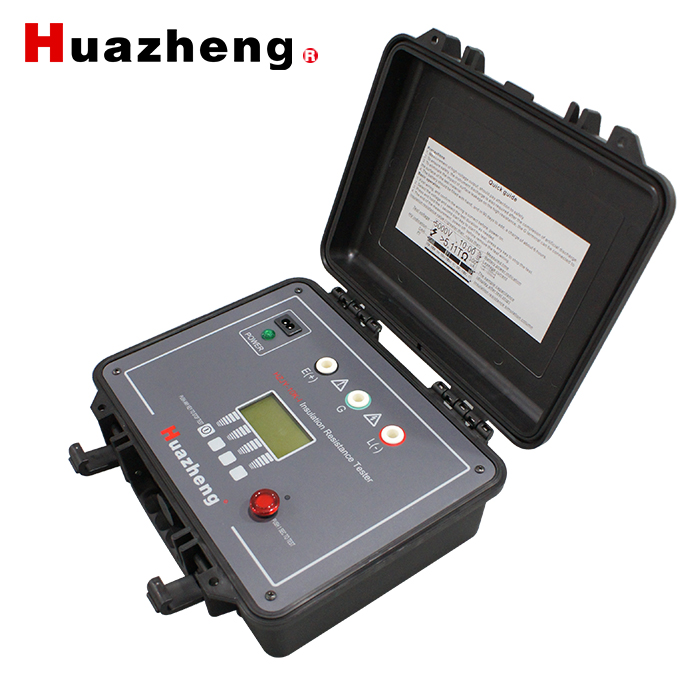
Select a megohmmeter with an appropriate voltage level. Generally, 2500V is used for distribution transformers and 5000V for large main transformers. Connect the L line terminal, E ground terminal, and G shield terminal respectively. Connect L to the winding under test, E to the transformer enclosure for reliable grounding, and G to the shielding ring on the bushing surface to eliminate the impact of surface leakage.
Smooth pressure increase measurement
Shake the megohmmeter at a constant speed or turn on the electronic megohmmeter to increase voltage, ensuring the output voltage remains stable. Measure the insulation resistance of three groups: high voltage to ground, low voltage to ground, and high voltage to low voltage. After allowing the readings to stabilize for 15 seconds and 60 seconds, calculate the absorption ratio and polarization index.
Data determination and recording
By comparing the standard procedures and historical factory data, if the values are on the lower side and the absorption ratio fails to meet the standards, it indicates that the insulation may be affected by moisture, aging, or dirt. It is essential to keep comprehensive records of the environmental temperature, humidity, test voltage, and the actual measurements of each group.
Discharge finishing
After the test is completed, disconnect the test wires first, then shut down the instrument, fully discharge the tested winding and bushing to ground, remove all wiring, tidy up the instrument site, and complete the inspection.
HZJY-10K-I 10kV IR Insulation Resistance Tester



Contact : Summer Xu

Position: Sales Manager

Email: sales04@bdhuazheng.com

Cellphone/ wechat/Whatsapp /Skype : +86 18330222302

Address: Unit 3, Building 9, No. 3099 Xiangyang North Street, Gaokai District, Baoding,Hebei,China,Zip: 071000

 sales04@bdhuazheng.com
 +86 18330222302
 +86 18330222302
 +86 18330222302
 +86 18330222302
