 Email:sales04@bdhuazheng.com
 Cellphone/ wechat/Whatsapp /Skype: +86 18330222302




Email:sales04@bdhuazheng.com
Cellphone/ wechat/Whatsapp /Skype: +86 18330222302

Its main business is the production, manufacture and sales of electrical equipment and testing instruments.
Products
 HOME >> Products >> Transformer Test Equipment >> Short-Circuit Impedance Tester
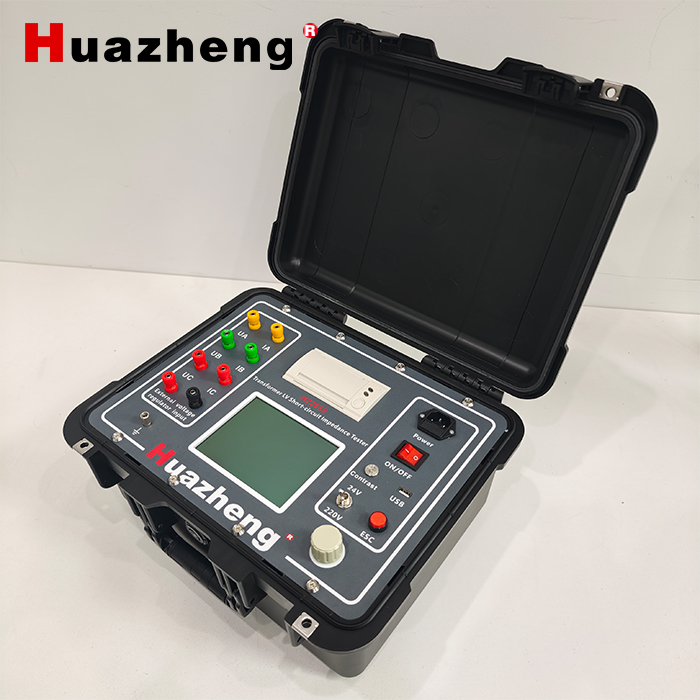
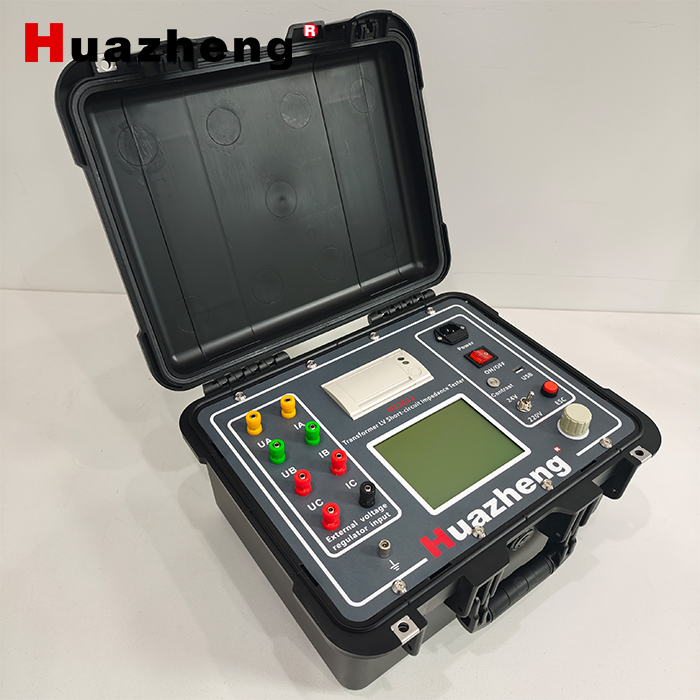
Short-Circuit Impedance Tester
Transformer Short Circuit Impedance Tester
Its main business is the production, manufacture and sales of electrical equipment and testing instruments.
I. Overview And Features Of The Instrument
[Instrument Overview]
During the testing process of power transformers, inter-turn or inter-phase short circuits may occur, or collisions may happen during transportation, causing relative displacement of the coil, and deformation of the coil due to electromagnetic force during operation in short circuit and fault states. This will change the distributed parameters of the transformer windings and consequently affect and alter the original impedance characteristics of the transformer.
The No. [2000] 589 document entitled "25 Key Requirements for Preventing Major Accidents in Power Production" issued by the State Power Corporation specifies in Article 15.2: "Transformers with a voltage level of 110 kV or above should be subjected to low-voltage short-circuit impedance testing or frequency response testing of winding deformation before leaving the factory or being put into operation to preserve the original records". Article 15.6 states: "After experiencing a sudden short-circuit in the near area, the transformer should be tested for low-voltage short-circuit impedance or frequency response of winding deformation, and compared with the original records. Only when it is determined that there is no fault in the transformer can it be put into operation". Low-voltage impedance testing can accurately reflect the changes in impedance values of the transformer before and after winding deformation. The "Guidelines for the Detection and Judgment of Inductive Method for Detecting Deformation of Transformer Windings" (DL/T1093-2008) stipulate that on-site testing power supplies can be used to measure the dynamic stability parameters of transformer windings and iron cores by means of low-voltage testing to determine whether the transformer windings are deformed or displaced. The dynamic stable state of the winding and iron core is determined. The guidelines provide provisions or suggestions for the testing timing, testing parameters, testing methods, testing instruments, judgment principles, and quantitative limits for judgment.
This product uses synchronized sampling of voltage and current, high-speed digital signal processing, and accurate measurement data. The instrument can use an internal output power supply or an external power supply and adopts a step-by-step measurement method. For three-phase transformers, manual or automatic measurement can be performed, and the data can be stored long-term in the internal memory. The instrument comes with data printing function.
Performance Features:
The technical performance fully complies with the technical requirements of the national standard DL/T1093-2008 "Guidelines for the Detection and Judgment of Transformer Winding Deformation by Impedance Method".
Two modes of internal and external power supply are used. The internal power supply provides two levels of 24V and 220V. For the first test, the 24V gear should be selected to prevent excessive short-circuit current. The 220V gear can only be selected when the test current is less than 1A.
High-performance embedded processing chips, digital narrow-band filtering technology, and other technologies are used to effectively suppress power frequency and high-frequency interference.
The three-phase connection method is used for phased measurement. Only the low-voltage side needs to be short-circuited, and the high-voltage side needs to be connected with three phases at one time. The short-circuit impedance of each phase can be calculated automatically after one-time measurement.
Two modes of manual measurement and automatic measurement are optional during the measurement process. For the first test, the manual measurement mode can be used to observe the measured current and voltage as a trial. The automatic measurement mode automatically completes the measurement and calculation.
During the measurement process, synchronously acquire voltage, current, frequency, active power, short-circuit impedance, short-circuit reactance, leakage inductance, etc.
Support test data generation, printing and output.
Short-circuit protection ensures that the instrument will not be damaged in case of accidental short-circuit during wiring.
Its main business is the production, manufacture and sales of electrical equipment and testing instruments.
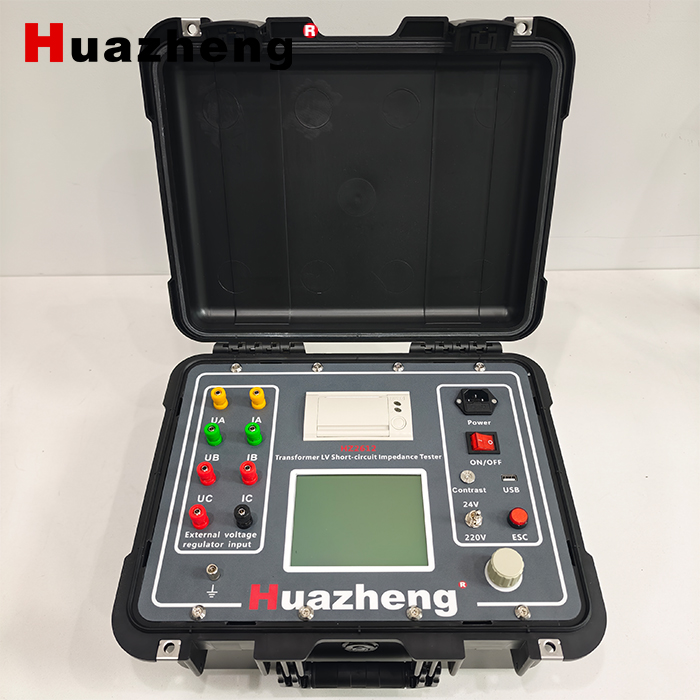
HZ2612 Transformer Short Circuit Impedance Tester



Contact : Summer Xu

Position: Sales Manager

Email: sales04@bdhuazheng.com

Cellphone/ wechat/Whatsapp /Skype : +86 18330222302

Address: Unit 3, Building 9, No. 3099 Xiangyang North Street, Gaokai District, Baoding,Hebei,China,Zip: 071000
 sales04@bdhuazheng.com
 +86 18330222302
 +86 18330222302
 +86 18330222302
 +86 18330222302
